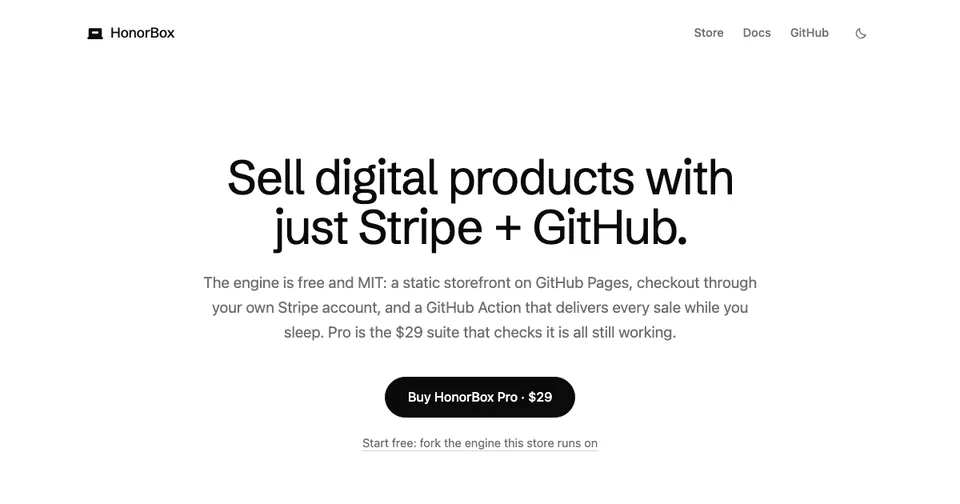
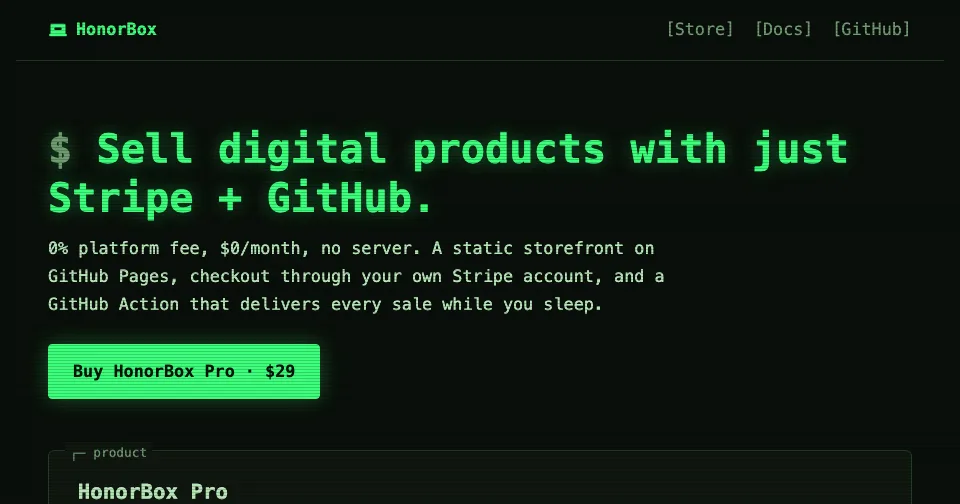
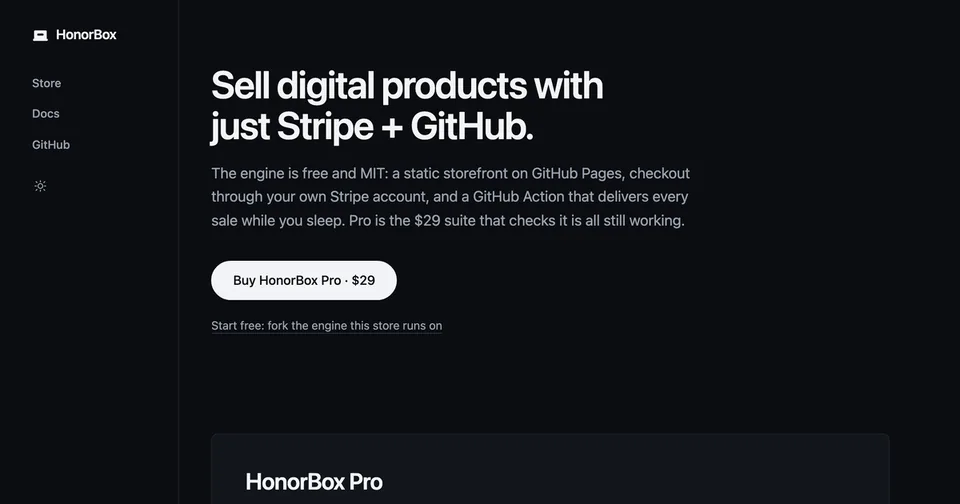
Sell digital products with just Stripe + GitHub.
The engine is free and MIT: a static storefront on GitHub Pages, checkout through your own Stripe account, and a GitHub Action that delivers every sale while you sleep. Pro is the $29 suite that checks it is all still working.
Start free: fork the engine this store runs on
A GitHub repo invitation expires after seven days, and nothing in Stripe will ever mention it. Pro walks every paid order against live GitHub access, names the ones that never landed, and keeps asking on a schedule. Point it at the setup you already run.
- Bring your own store: Pro runs on the Stripe payment links and private repos you already have. One config file, no migration, and your checkout URL never changes
- Reconcile: walks every paid Stripe order against live GitHub access and names the ones that never reached the buyer, with the amount attached
- The audit: a conformance suite of 17 checks for the known ways this architecture loses money quietly, each one proven able to fail and wired to a CI gate that goes red when your setup drifts
- The scheduled guard: runs the audit and reconcile four times a day and opens one self-closing issue in your own repo naming what went red. A run that could not reach Stripe alarms too, so it never reads as healthy
- Refund and dispute guards: repo access is revoked the moment Stripe says the money left, without waiting for you to run anything
- Also inside: the store doctor, tracker-free sales stats, the rail storefront theme, offline license keys, the commerce playbook, and the priority support label
New
10 specialist agents and 14 discipline skills for Claude Code, designed as one system and installed in one command.
- 10 specialist agents: reviewer, debugger, planner, tester, security, perf, refactorer, docs, simplifier, captain
- 14 discipline skills: TDD, verification-before-done, PR authoring, accurate changelogs, safe shipping
- Six safety hooks: git, shell, exfil, scope and secret guards, plus post-edit format (commented, auditable shell, with test suites)
- CLAUDE.md starter templates for solo and team repos
- One-command installer with dry-run, conflict detection, and clean uninstall
- Free tier on GitHub: 3 agents + 3 skills, MIT, try before buying
30 days, no questions asked, refunded through Stripe to the card you paid with. And because the engine is MIT-licensed and delivery is a private repository your GitHub account keeps, what you buy does not stop working if this project does. It is new, and the release history says exactly how new.
How the honor box works
Fork the stand
Fork the free, MIT-licensed engine and edit one config file. Your storefront builds to GitHub Pages; hosting costs $0, forever. None of that is paywalled: the setup guide is in the repo, and this page was built by the engine it describes.
Put out your goods
Create a Stripe Payment Link for each product and drop the URL in the config. Buyers pay you directly on your own Stripe account, so the money never sits with anyone else on its way to you.
Let the box collect
A scheduled GitHub Action polls Stripe, invites each buyer's GitHub account to your private product repo, and keeps your books. No webhooks, no server, no database.
The one hard requirement: your buyers need GitHub accounts, because delivery is a repo invite. The second thing to check is your price. The cheapest merchant of record takes 5% + 50¢ and does your VAT; on your own Stripe account you pay Stripe's 2.9% + 30¢ and the VAT is yours. At ten sales a month that difference is about $8 on a $29 product, about $23 at $99, and about $44 at $199, because the fee scales with your price and the VAT work does not. Under about $30 a sale, letting them handle it is the better trade and the first guide below shows why. Above it, you are paying a growing percentage for paperwork that costs the same either way.
Change the whole look with one config line
Real screenshots of this same storefront rebuilt with each theme. Two ship free in the repo, readable in full before paying for anything. Pro adds rail.
Side by side
Fees as published on each vendor's own pricing page, checked July 2026. Polar is the closest comparison: it delivers private-repo access natively and instantly, and it handles your VAT. What the first three sell you is the VAT and the compliance, priced as a share of every sale for as long as you sell. That is worth paying on a cheap product and worth owning on an expensive one, which is the trade the guides below work through.
What you can check before you buy
This project has no track record to point at yet. These are the substitutes, and every one of them is something you verify yourself rather than something we assert.
scripts/fulfill.js is the entire fulfillment path: poll Stripe, match the order, invite the buyer. No dependencies, no framework, readable in one sitting, and public before you pay a thing.
The store you are standing in is generated by the engine it sells, from a config file in the public repo. The checkout you would go through is the one your buyers would. It is the same artifact, not a demo of one.
Every change tagged, with notes naming the limits as well as the features. It also shows exactly how young this is, which is worth knowing before you spend anything.
The engine is MIT and that cannot be withdrawn later, by us or anyone. Your store runs on your Stripe account and your GitHub Action, so no server of ours sits in the path of a sale, and nothing switches off if this project goes quiet.
Straight answers
Is this free, or is it $29?
The engine is free and MIT: fork it, edit one config file, and you have a working store with checkout, fulfillment, docs and two themes. Nothing about it expires or phones home. The $29 is HonorBox Pro, a separate suite for a different problem: whether the store you just built is actually working. What the free core cannot tell you is whether a specific order reached the person who paid for it, because an empty ledger and a broken store look identical from the outside and you find out from the buyer. Start free. Buy Pro when you have a store to check. Fork the free engine
What exactly do I get when I buy?
Your GitHub account is invited to the product's private repository, usually within minutes and always within a few hours. You keep access permanently, updates included. If the invite doesn't arrive, the recovery path is written down and ends in either access or a refund. If a delivery fails
Why is there no instant download?
Because the product is private-repo access, which a download link can't be: per-buyer grants, clean revocation on refund, updates included forever. A scheduled job sends the invite, usually within minutes, with zero infrastructure to run or break. Sellers who want seconds can turn on the optional webhook mode. A download URL is instant, and then uncontrollable. How instant delivery works
Do my buyers need GitHub accounts?
Yes. Delivery is a repo invite, so every buyer needs one. Fine for code, templates, courses aimed at technical people, and tools. The wrong channel for lay-reader ebooks, physical goods, or general consumers. Better to know that before your first failed delivery.
I already sell through Stripe and GitHub. What does this add?
Keep it. Nothing here asks you to replace a setup that already works. Pro is the part worth adding, because it answers what a hand-rolled setup almost never answers for itself: is every paid order delivered right now, and is any of the known silent failures live in your store? Point it at what you already run. A minimal config naming your existing payment links and repos, plus one custom field on your payment link asking for the buyer's GitHub username, which is one API call and leaves the link URL unchanged. Reconcile, stats, the refund and dispute guards, the store doctor and the audit's money-path checks then run in full against your setup; the checks that only apply to the engine's layout skip and print why. The free engine is there if you ever want the storefront and the fulfillment glue too, and adopting it is a config file naming those same links and repos rather than a migration your buyers can see. Every line of this is checkable before you pay: the config, the checkout field, what runs in full, what steps aside with the lines it prints, and the limits. What runs on a store you built yourself
Does the fulfillment bot need my full Stripe secret key?
No. A restricted key that can only read Checkout Sessions runs the whole poll; it cannot move money, refund, or create anything. Pair it with a fine-grained GitHub token valid for just the product repo. The least-privilege guide in the docs shows the exact toggles. See the exact toggles
What about VAT and sales tax?
HonorBox is not a merchant of record. You sell on your own Stripe account, so tax obligations are yours. That's workable for most small sellers under registration thresholds, and Stripe Tax can automate it beyond that. The tax doc walks through what a small seller actually owes. What a small seller owes
Refunds?
30 days, no questions asked, refunded through Stripe to your original payment method. Repository access ends when a refund is issued.
Who's behind this, and how new is it?
An independent, MIT-licensed project. It publishes no company name or legal identity, and contact is honorbox@proton.me. There is no long track record here and no point pretending otherwise. What there is instead is a public record: the engine that takes the money is public, this store is built by it, the release history is dated from the first commit on 18 July 2026, and the refund is 30 days no questions. The support page sets out what an anonymous contact does and does not cost you, and what you are left holding if the project stops. Support and what you can check
Guides
Gumroad, Lemon Squeezy, Payhip, Paddle, plain Stripe, DIY: the real fees and when each one wins.
The two big platforms against your own Stripe account: fees from their live pricing pages, the per-sale math, and when not to DIY.
The complete guide: checkout, delivery options, refunds, and the tax paragraph nobody writes.
Private-repo delivery done right: access control, revocation, invite limits, and token discipline.
The direct route: Stripe checkout, GitHub delivery, the running costs added up, and when a marketplace earns its cut.