HonorBox
HonorBox Pro
A GitHub repo invitation expires after seven days, and nothing in Stripe will ever mention it. Pro walks every paid order against live GitHub access, names the ones that never landed, and keeps asking on a schedule. Point it at the setup you already run.
30 days to change your mind, no questions asked, refunded through Stripe. The refund policy in full.
Launch week: code PRODUCTHUNT takes 20% off at checkout, through 19 August.
What Pro is
Someone paid you and never got in. You would find out when they email you, if they email you.
Every expensive failure in this architecture has that shape: the money arrives, the delivery does not, and nothing anywhere says so. An invitation nobody accepts expires after seven days, and unless something re-issues it before then the sale is gone with nothing recording that it was ever at risk. A refund returns the money and leaves the collaborator in place, and a lost chargeback does the same. A payment link that went into your config as a URL where Stripe reports a plink_ id makes every sale of that product match nothing at all. Stripe says paid, GitHub was never asked, and the only buyer who tells you is the one who cared enough to chase.
Pro is the thing that asks instead. Reconcile walks every paid Stripe session and asks GitHub whether that specific buyer holds access to that specific repo right now: one verdict per order with the amount attached, and a non-zero exit when anything is lost, so you can schedule it rather than remember it. Alongside it, the audit: a conformance suite of seventeen checks for the known ways a Stripe-plus-GitHub store loses money without telling you, run against your own account and wired to a CI gate.
And because the ways a store breaks do not arrive by push, the asking runs on a clock as well as a gate: a scheduled guard re-runs the suite and the reconciler four times a day and raises an issue in your own repo the day something goes red, so a silently broken store becomes a loud notification within hours instead of a theory you form weeks later from an absence of sales.
If you have not launched yet, you have the same problem one step earlier. An empty ledger looks identical whether nobody came or the store is quietly broken, and almost every way this architecture fails returns a perfectly healthy-looking response: a payment link you deactivated still answers its URL with HTTP 200 and the ordinary Stripe checkout page, so a link checker, an uptime monitor and a curl in CI all agree your dead buy button is fine. Only the API knows, and nothing is asking it. Most of the suite's checks need no orders at all, which is the point: they are useful on the day you launch, not after you have lost something.
Around both sits the rest of the operational half: the store doctor catches setup mistakes before they cost you a launch, and the refund guard revokes what a refund should revoke without waiting for you to run a command.
It runs on the store you already have
You made your payment links in the Stripe dashboard. You deliver by inviting the buyer to a private repo, with glue you wrote once and have not opened since. That is the setup this was built for, and you do not have to adopt the engine to put Pro on it. Write a minimal config naming the payment links and product repos you already have, and add one custom field to your payment link asking for the buyer's GitHub username. On a link you already sell through that is one API call, not a dashboard edit, because Stripe offers no way to edit a payment link once it exists. The link URL does not change, so nothing you have already published goes stale. Reconcile, stats, the refund and dispute guards, the store doctor and the audit's money-path checks then run in full against your setup as it stands.
Straight about the parts that do not. Checks written for the engine's own storefront layout skip, print the reason, and are counted apart from the passes rather than quietly passing. No ledger is required, and with none there the two history checks step aside and reconcile answers the same questions from live Stripe and GitHub state instead. The suite is young: it catches what has been catalogued and nothing else. Check all of that before you pay rather than after: what runs on a store you built yourself has the config, the checkout field, the modules that run in full, the ones that step aside with the lines they print, and the limits. If you later want the storefront and the fulfillment glue too, adopting the engine is a config file naming those same links and repos, not a migration your buyers can see.
You could write the diff yourself in an afternoon. The reason to buy this instead is what the homemade version does when it is wrong. A check that compares paid sessions against collaborators gets the cases that matter backwards: a pending invitation looks like a loss, an expired one looks identical to a pending one, a refunded buyer who still holds access looks delivered, and if one payment link went in as a URL where Stripe reports an id, nothing matches at all and the run reports zero failures. A reconciler that matches nothing reports everything clean. That is not a hypothetical we are selling against: the first version of one check in this suite could not be made to fail at all, and what found it was a mutation suite that breaks each check on purpose and requires it to go red. Every check has to survive that now, which is the part you are actually buying.
Who should buy this (and who shouldn't)
Buy Pro if you are already taking orders and want each one proved delivered rather than assumed. Buy it too if you have a store set up and a launch coming, and you would rather find out now than infer it later from an absence of sales: you get one launch, and a misconfigured grant or a dead buy button burns it while every local signal tells you the store is fine. Buy it if you sell or plan multiple products, if your product runs on machines you cannot see and needs license keys, or if you want a storefront that doesn't look like every other fork.
Delivery is a private repo, so read the box before you buy it. Public and checkable right now: the license module's full API surface with the key format and both verify snippets, the playbook's complete table of contents, what every module prints, in its real format, and what runs on a hand-rolled store, so you can see the answer each one gives before you pay for the code behind it.
Skip Pro if you have not actually set a store up yet. There is nothing for the suite to check, and the free core is a complete store on its own. Skip it if you're selling one PDF or template, or if you're happy in CSS and would rather restyle the free theme yourself, which the theme contract makes easy.
And skip it if you are buying it to feel like you have started. That is the most common reason anyone buys a tool like this and it is the wrong one. The suite is worth $29 when there is a real store with real money moving through it, or a real launch date for one. It is worth nothing as a substitute for having either.
What's inside
The audit. The conformance suite, and the largest thing Pro ships. It is called audit everywhere you will meet it: in the command you run, in the transcripts, and in the docs. It reads your config and your sources, and with a read-only Stripe key it asks the API about the objects behind them. Some of what it catches:
- a dead buy button: a deactivated payment link answers HTTP 200, so nothing else you own will notice
- price drift: the number printed on your product page against the number its link actually charges, in the right minor unit for the currency, declining to guess when the page says something like "from $19"
- a pasted checkout URL where Stripe reports a
plink_id, which makes every sale of that product silently unmatchable - a forked store still selling through the original author's checkout, which banks your customers' money into someone else's account
- a live 100%-off coupon on a link that accepts typed codes
- a poll cadence that outruns the Actions free tier and then stops delivering
- no request deadline on a money-path
fetch, where one hung socket stalls every buyer queued behind it
It is static analysis, configuration checking and read-only API reads. It does not execute your code and it cannot see a failure nobody has catalogued. Where it could not check something it prints UNKNOWN and the reason, never OK, because a suite that silently skips what it cannot check is worse than no suite: it produces a clean report about a store nobody examined. There is no score, because a number would invite you to feel 82% safe and there is no such thing here.
Every check is proven able to fail. A mutation suite builds a correct store, asserts it is green, breaks the exact thing each check guards, asserts that check goes red, and asserts it returns to green on revert. A check that cannot be made to fail is decoration. This is not ceremony: the first version of one check could not go red at all, because the code pattern it scanned for satisfied its own test, and running the mutation suite is what found it.
The full failure catalogue is published free: fourteen entries, each one a way this architecture is known to lose money, with the incident or defect that put it on the list and the gaps we have not closed. The seventeen checks are what detect them, because a few of those failures take more than one check to catch. Take it, post it, work through it by hand. What Pro sells is the part that keeps working after you have stopped thinking about it. See exactly what the audit prints, on a store with four ordinary mistakes in it.
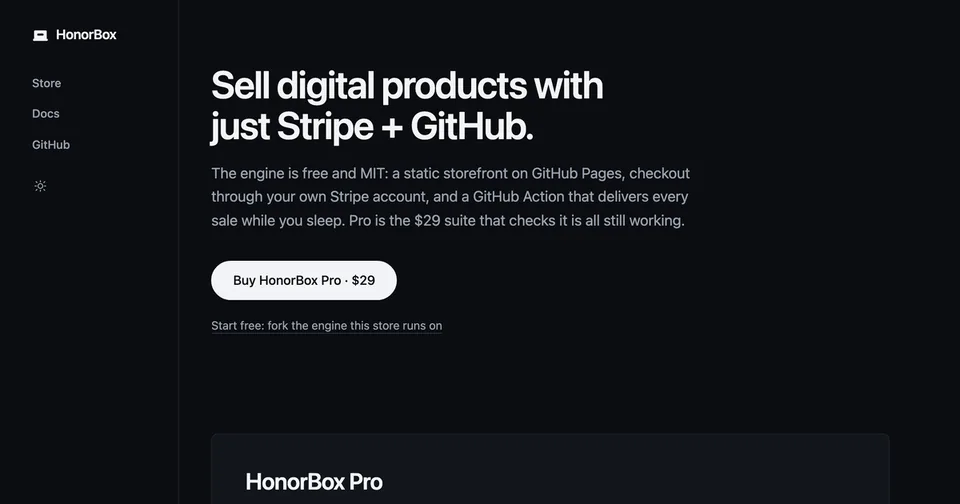
The rail theme. A fixed left navigation column instead of a centred page: the store's structure stays on screen while the reader moves through it, which is what a catalogue of any size actually needs. Complete and hand-tuned, with fluid type, visible focus states, print styles, and a light and dark palette built as mirrors. Switch with one config line.
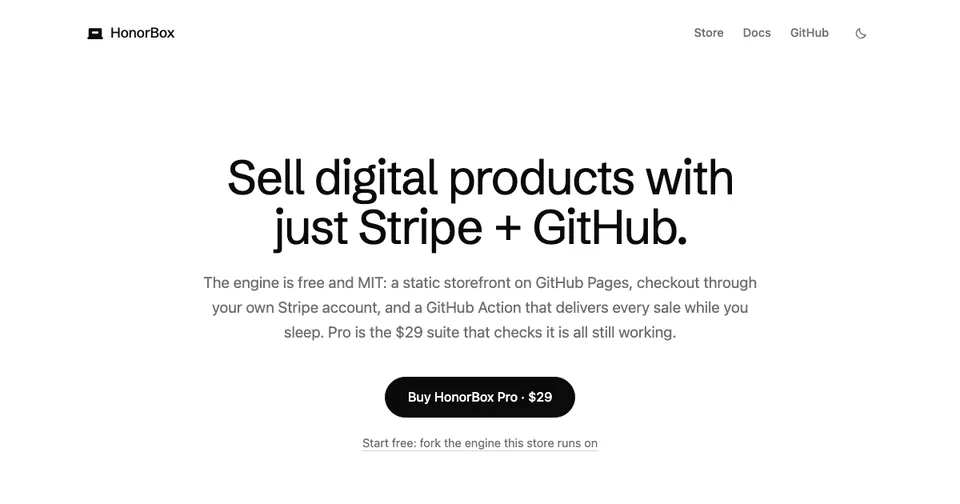
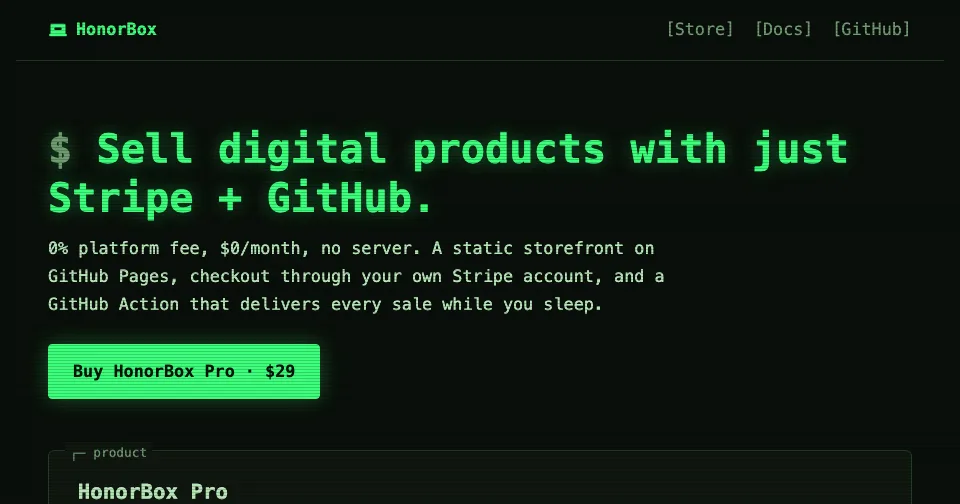
We shipped one theme here rather than a pack. Four others were built and cut, because a theme that does not hold up is worse than no theme in something you paid for. The free repo's stand and terminal are built to the same class contract and can be read in full before paying for anything.
The store doctor. One read-only command that checks your whole pipe: config shape, the pasted-URL-instead-of-id mistake, whether your payment links are live, whether your fulfillment token can actually invite buyers, whether your product repo is accidentally public. Run it before launch; sleep after.
Reconcile. Doctor checks that your store is set up right, which you ask once. Reconcile answers the question that only starts costing money after launch: for every order you were paid for, does that buyer have the product right now?
Those are different questions, and the free engine does not answer the second one. It writes its ledger row the moment it sends an invite, so a buyer who never clicks accept leaves every system you own reporting success: Stripe says paid, your ledger says delivered, the run is green. They have nothing.
The engine will not let that invitation lapse quietly. It re-issues an unaccepted one before GitHub's seven-day expiry, three times, then warns you by name: about three and a half weeks of open door, and it is part of the free engine, because a sale that never lands was never delivered (how that works).
That is also where it stops. Renewal works from GitHub's list of pending invitations and holds no Stripe key at all, so it can keep an invitation alive but never tell you which paid order it belongs to, or how much money is sitting undelivered. And it never sees a failure that left no invitation to renew: an order that matched no grant, a typo'd username the engine flagged and skipped, a refunded or charged-back buyer who kept access.
Reconcile starts from the money instead. It walks every paid Stripe session and asks GitHub whether that specific buyer holds access to that specific repo: one verdict per sale with the amount attached, PAID, NO GRANT on an order the engine never fulfilled, a repo it cannot read reported as unreadable rather than counted clean, and a non-zero exit when anything is lost, so you can schedule it instead of remembering it. Read-only.
It also separates revenue from fulfillments: a $0 order fulfilled by a coupon is a delivery, not a sale, and reconcile reports them apart so your revenue line means money that actually arrived.
The scheduled guard. The suite and the reconciler exit non-zero when something is wrong, and an exit code is only an alarm if something watches it. The guard is a ready-to-copy GitHub Actions workflow for your private ops repo: on a schedule it runs both against your live store, and when anything goes red it opens one GitHub issue naming the exact failing checks and undelivered orders, with the fixes. The same issue updates while things stay red, a change posts a comment so it notifies, and it closes itself on the first green run. A run where Stripe or GitHub did not answer is reported as "the guard could not see", never as a green run. No server, no webhook, no third-party monitor holding your keys: GitHub already notifies you about issues in your own repo, and the guard gives it something true to say.
Ops bots. Two workflows for the unattended hours. One acknowledges and labels every new support issue within minutes. The other watches Stripe for refunds and revokes the buyer's repo access and pending invites the moment one lands.
Stats without trackers. One command renders gross, net, AOV, refund rate, revenue by week, and buyers by country into a single offline HTML report, computed from your Stripe account. Your storefront never loads an analytics script.
Multi-product patterns. The engine sells several products out of the box. The playbook chapter covers what breaks after that: why each product wants its own private repo, how to build a bundle that grants several repos from one payment link, how a refund revokes what that purchase granted and nothing else, and the order you retire a product in so a checkout completed a minute before deactivation still gets fulfilled.
The license-key module, if you need it. A GitHub Action that signs an ed25519 license for each buyer at fulfillment time, plus drop-in verification snippets for JavaScript and Python. Your app checks licenses offline: no license server, no phoning home, nothing to keep running. Signing happens in CI with the private key held as an Actions secret.
Worth being straight about who this is for. HonorBox delivers entitlement as repo access, and if your entitlement is repo access you do not need a license key at all. This module is for sellers whose product is installed somewhere else and has to check for itself: a desktop app, a plugin, a CLI that runs on a machine you will never see. That is a real need for a real minority, and it is the least representative thing Pro contains, so it is down here rather than at the top. Its complete API surface, key format and both verify snippets are published, so you can judge it before paying.
The commerce playbook. Four documents: picking your number against real comparables, running a launch price you can honor, the first ten sales of a store nobody has heard of, and an EU VAT primer with two worked registration examples. Every chapter title and a one-line summary of each is published so you can see the shape of it before paying.
How delivery works
Checkout asks for your GitHub username. The fulfillment bot invites that account to the private Honorboxx/honorbox-pro repository, usually within minutes and always within a few hours. You keep access permanently; updates land in the same repo. It's the same private-repo delivery we recommend in the GitHub delivery guide, so you're watching the engine you'd be buying.
Licences
Pro is licensed per developer. If more than one person on your team will read or run it, the team licence is cheaper than buying copies, and it is meant to be: we do not enforce this with keys or phone-homes, so it has to be easier to obey than to ignore.
| Price | Covers | |
|---|---|---|
| Solo | $29 | one developer, unlimited projects of your own or your clients' |
| Team | $99 | up to 5 developers at one company |
| Company | $249 | every developer at one company, and the licence transfers with the company rather than dying with an employee |
Solo is the buy button on this page. For Team and Company, email honorbox@proton.me and you will get a checkout link and an invoice made out to the company. Each seat is a GitHub account invited to the private repo, so send the usernames with the order or afterwards, whichever suits.
Terms
- One-time. No subscription, no upsell treadmill.
- Updates: every update to Pro v1 is included at no extra cost, and lands in the repo you already have access to. A future v2, if there ever is one, would be a separate purchase. We would rather write that down now than surprise you with it later.
- Licensed per developer at the tier you bought. Use it in any number of your own stores.
- Don't republish or resell the Pro content itself.
- 30-day refunds, no questions asked, via Stripe.
- Support through GitHub issues; Pro buyers get the priority label.